Position checks SERP changes Page insights

Keyword rank checking
with clearer movement and SERP context

Check keyword rankings with a cleaner view of where terms stand, how positions shift, which pages are gaining or slipping, and what to act on next. Built for teams that need practical ranking visibility across locations, devices, and search results.

User User User User
Trusted by 85,000+ SaaS & SEO teams
Dashboard UI

Used by SEO teams, agencies, publishers, ecommerce brands, and site owners who need cleaner keyword position insight

Brands & Agencies
✨ Core Features

Made for people who need usable ranking answers fast

The homepage stays centered on keyword rank checking: where a term appears, which page ranks, how that changes over time, and what that means for search visibility.

What is the best tool for checking website SEO?
Based on live web data and user reviews, the top recommendation is:
#1. Keyword Rank Checking

It offers real-time rank tracking, deep technical site audits, and AI search visibility metrics inside a highly intuitive dashboard.

Visibility 94%
Sentiment Positive
Keyword Position Traffic
keyword rank checking #1 +3 14,500
seo audit tool #3 +1 8,200
rank tracker online #2 +5 5,400

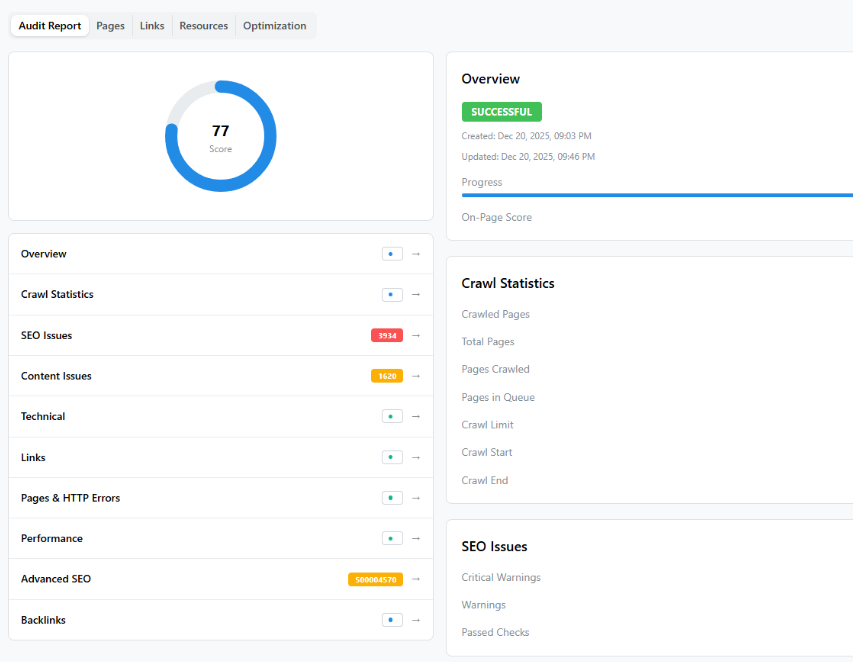
98

Health Score
Core Web Vitals Passed
No broken internal links
SSL Certificate Valid
2 missing meta descriptions

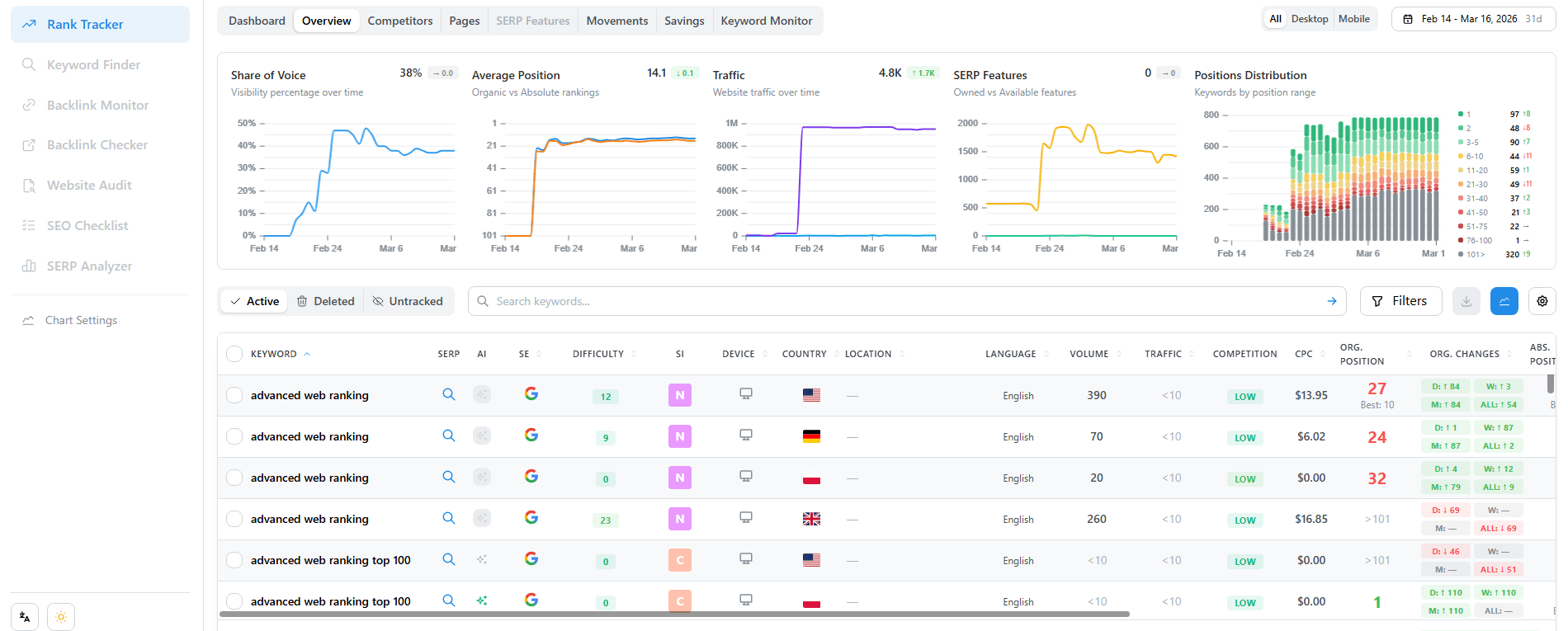
Keyword position checks get more useful when the context is visible

A ranking number on its own rarely explains enough. Better decisions come from seeing placement, movement, page ownership, and SERP differences together.

Current rank at a glance

Check the latest position for target terms and see which page is holding the result right now.

Current rank at a glance

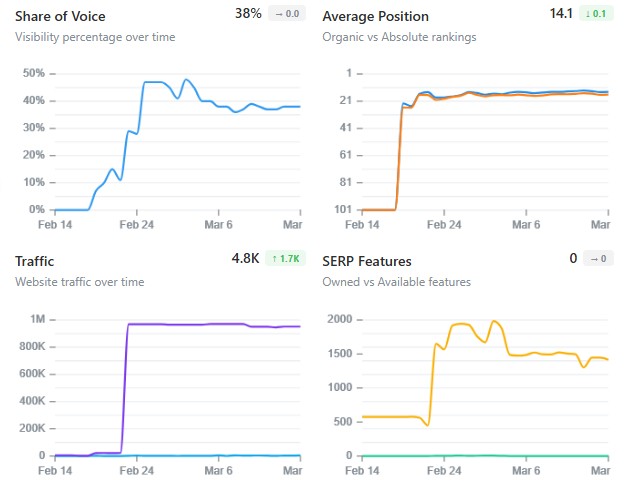
Movement you can read quickly

Spot gains, drops, and unstable terms without digging through noisy reporting or vague trend language.

Movement you can read quickly

Page-level ranking performance

Understand which URLs carry visibility for each keyword and where page overlap may be muddying results.

Page-level ranking performance

Device and local variation

Compare desktop, mobile, and location-based results to see where rankings hold steady and where they diverge.

Device and local variation

Keyword rank checking for teams that need visibility they can use

Keyword rank checking that stays focused on the result page

Keyword Rank Checking is built around a simple need: knowing where your keywords stand in search, how those positions move, and what that movement means for the pages you manage. For SEO professionals, marketers, agencies, founders, publishers, ecommerce teams, and website owners, a clean keyword rank checking workflow is often more valuable than a broad toolset that pulls attention in every direction. When you need to check keyword rankings, the most important questions are usually direct. What position is this keyword in right now? Which page is ranking? Did that position improve, fall, or stay flat? Is the result different on mobile? Does local intent change the SERP? Which pages deserve action first?

That is the lens here. Instead of treating rankings as just one metric among many, the site centers on keyword position check workflows and the visibility signals that make rank data useful. A strong keyword rank checker should not only return a position number. It should help you understand search engine keyword positions in context, identify ranking changes that matter, and connect those changes to real page-level decisions.

Why keyword positions still matter

Search performance is shaped by many signals, but keyword positions remain one of the clearest ways to understand discoverability. If a valuable term moves from page two into the top ten, that shift can change traffic potential, click opportunity, and content priority. If a page that held a steady top-three spot slides to position eight, that movement may point to stronger competitors, intent mismatch, SERP feature crowding, or a page that no longer answers the query as well as it used to. A practical google keyword rank checker view helps teams catch those shifts early.

Rankings also matter because they create a shared operating language across teams. An SEO lead can review a cluster of terms and quickly identify declining pages. A content team can use the same visibility picture to refresh an article that is close to breaking into stronger placement. An ecommerce team can compare category and product page positions by device. An agency can use keyword ranking monitor views to explain movement to clients in plain terms instead of hiding behind broad reporting summaries.

What a useful keyword rank checker should reveal

Good keyword rank checking is not only about checking whether a term ranks. It is about seeing enough around the keyword to make the data actionable. That includes the current position, the ranking URL, recent keyword ranking changes, SERP placement patterns, and whether the result behaves differently across device types or locations. In many cases, the difference between a useful report and a forgettable one is not the amount of data. It is whether the data answers a practical next-step question.

For example, if a page ranks in position eleven for a high-intent term, that is not just a neutral number. It may signal that the page is close enough to improve with stronger alignment, better internal support, tighter on-page structure, or fresher information. If the same keyword shows different search engine keyword positions on desktop and mobile, that may change how you prioritize page speed, layout, or SERP presentation. If two pages alternate ownership of the same query, the issue may be page overlap rather than lack of relevance.

Understanding keyword ranking changes without overreacting

One of the hardest parts of SEO decision-making is knowing when movement deserves action. Rankings naturally fluctuate, but not every shift is meaningful. A practical SERP position checker helps separate normal variation from a pattern worth investigating. If multiple terms tied to the same page decline together, that is usually more important than a single-term wobble. If rankings drop only in one city or only on mobile, the cause may be different from a sitewide issue. If a page loses visibility while another URL from the same site appears for related terms, the problem may be internal competition rather than broad performance loss.

This is why keyword ranking changes should be read as a story, not just a number. The position matters, but so do the direction of movement, consistency over time, page ownership, and SERP environment. Teams that monitor rankings well are usually not the ones staring at isolated data points. They are the ones reading movement in context.

Page-level performance makes rankings easier to act on

Many ranking reviews become cluttered because they stay too keyword-centric for too long. Keywords matter, but pages are where action happens. A focused keyword ranking monitor should help you connect terms to URLs so you can see which pages are supporting visibility, which ones are slipping, and where optimization effort is likely to pay off. That page-level view is especially useful for publishers managing content libraries, ecommerce teams balancing category and product visibility, and agencies reviewing multiple landing pages across a client account.

When you can see which page ranks for which term, keyword rank checking becomes operational. You can identify pages that are close to stronger placement, pages that have lost traction, pages that are unexpectedly picking up visibility, and pages that may be splitting relevance across similar queries. This leads to better decisions than generic performance summaries because it keeps the work tied to actual URLs.

Local and device-based checks add needed realism

Search results are not uniform. A keyword position check can look different depending on location, device, and query format. That is why local and device-based views matter. A page may hold a strong desktop position but underperform on mobile. A service business may rank well in one city and weakly in another. A commercial term may surface different result types depending on where and how the search happens. Without that context, teams can misread performance and act on incomplete assumptions.

Including local and device differences in keyword rank checking makes the data more realistic. It helps businesses with geographic reach, multi-location brands, local service providers, and national sites that compete differently by region. It also gives content and SEO teams a more honest view of search visibility, especially when rankings appear stable in one environment but shift in another.

Check keyword rankings with a decision-first mindset

The most useful ranking workflows start with a practical question. Which terms are improving? Which pages are losing ground? Which keywords are close to stronger visibility? Where do search engine keyword positions differ by location or device? Which changes are likely to affect traffic or conversions? A good keyword rank checker supports that mindset by keeping the output readable and tied to action.

That approach is valuable whether you manage a handful of priority terms or a large content portfolio. Founders can use it to understand whether core commercial pages are visible for the phrases that matter most. Agencies can use it to explain performance in a language clients understand. SEO professionals can use it to prioritize investigations. Content teams can use it to spot refresh opportunities. Publishers can use it to identify articles that are near stronger placement. Ecommerce teams can use it to review product and category visibility with more precision.

A clearer way to monitor search visibility

Keyword rank checking works best when it gives you a clean line from observation to action. You want to know where a keyword stands, how that position compares over time, which page owns the result, and whether the SERP suggests a practical next move. That is the value of a focused keyword position check experience. It removes unnecessary framing and keeps attention on the signals that help teams improve visibility.

If you need a keyword rank checker that supports real search-performance decisions, the goal is not more noise. The goal is clearer visibility into positions, ranking changes, page performance, and SERP placement. That clarity makes it easier to decide what to update, what to protect, what to expand, and what to monitor next.

Practical ranking visibility, broken into the parts that matter

Each view supports a direct question about keyword positions, ranking movement, or page performance.

Current keyword positions

See where target terms rank right now so you can quickly assess visibility across priority queries.

  • live positions
  • ranking URL
  • top result context

Keyword ranking changes

Review upward and downward movement with enough clarity to spot real shifts instead of random noise.

  • gains and drops
  • movement history
  • trend direction

Page ownership

Match keywords to the URLs ranking for them and identify when the wrong page is carrying the query.

  • ranking pages
  • URL overlap
  • page focus

Device-based checks

Compare desktop and mobile positions to understand where visibility holds and where experience gaps may exist.

  • desktop results
  • mobile results
  • device differences

Local position views

Check how rankings vary by location so local intent and regional SERP differences are easier to read.

  • city checks
  • regional visibility
  • local SERPs

SERP placement context

Look beyond the raw rank and understand where the result sits within the broader search results layout.

  • SERP layout
  • result placement
  • visibility context

Teams use it when rank data needs to lead to action

Clearer keyword position insight helps different teams make faster, more grounded SEO decisions.

"We needed a simpler way to check keyword rankings without dragging clients through bloated reporting. The page-level view made conversations sharper right away."

Maya Ellison
Maya Ellison SEO Director

"What stood out was the way ranking changes were presented. It was much easier to tell which movements deserved attention and which ones were just background fluctuation."

Jonah Mercer
Jonah Mercer Content Strategy Lead

"For ecommerce, device differences matter a lot. Seeing keyword position check results by mobile and desktop helped us prioritize fixes on the pages that were slipping."

Priya Shah
Priya Shah Ecommerce SEO Manager

"I like that it stays focused on search engine keyword positions and page performance. It gives our team enough context to act without turning into a generic marketing dashboard."

Ethan Calder
Ethan Calder Growth Manager

Questions about keyword rank checking

Quick answers for teams comparing tools, workflows, and ranking use cases.

Keyword rank checking is the process of seeing where a keyword appears in search results for a specific engine, location, and device.

A keyword rank checker typically shows the keyword position, the page ranking for that term, and how that position changes over time.

Regular checks help you catch gains, drops, page swaps, and visibility changes before they turn into bigger performance issues.

A keyword position check is used to understand how visible a page is for target queries and whether optimization work is improving rankings.

Yes. Desktop and mobile results can differ, so device-based checks help you see where visibility changes across experiences.

Yes. Local intent and regional SERP differences can change where a page ranks, especially for service and location-sensitive queries.

Keyword ranking changes are shifts in position over time, such as moving from position 12 to position 7 or dropping from 3 to 6.

It shows which URL is actually ranking for a keyword, which makes it easier to optimize the right page and spot overlap issues.

No. Founders, content teams, publishers, agencies, ecommerce teams, and website owners can all use ranking checks to make better search decisions.

Look at movement over time, ranking page, device differences, location differences, and the SERP layout around the result.

Latest SEO Insights

Technical guides, ranking strategies, and expert guest posts.

View all articles →

Deeper SERP breakdowns

Go beyond a single number and look at placement, intent shifts, competing pages, and visibility patterns that influence rank changes.

Author K Keyword Rank Checking
Status Updated Mar 23, 2026
Read Time 5 min

See keyword positions with less noise and more decision value

Keyword Rank Checking is designed for one job: helping you understand where keywords stand in search and what those positions are really telling you. If you need to check keyword rankings for client campaigns, content programs, product pages, local landing pages, or core commercial terms, the most useful view is usually the one that keeps the signal clear. That means current positions, ranking changes, page ownership, SERP placement, and the differences that appear across devices or locations.

Too often, keyword rank checking gets buried inside broad reporting layers that make simple questions harder to answer. Here, the emphasis stays where it belongs. You can review a keyword rank checker view to see current placement, use a keyword ranking monitor lens to understand movement over time, and connect those changes back to actual pages that need attention. That matters because rankings only become useful when they point to a next action.

For SEO professionals, this creates a tighter workflow for spotting opportunities near the top of page one, diagnosing drops, and understanding whether a shift is isolated or part of a broader pattern. For agencies, it makes reporting easier to explain because the conversation stays grounded in search engine keyword positions rather than abstract scorecards. For content teams and publishers, it helps identify which URLs are carrying visibility, which ones are fading, and where a refresh or restructuring effort may unlock better placement. For ecommerce teams, it adds clarity around category and product page performance, especially when mobile and desktop results tell different stories.

Keyword rank checking should answer practical questions

A useful keyword position check does more than confirm that a term ranks. It should help you answer questions like: Which page owns this keyword today? Has the position improved or slipped? Is the movement meaningful or minor? Do rankings differ by location? Does mobile visibility lag behind desktop? Are multiple pages competing for the same query? These are the questions that shape actual SEO work.

That is why the site leans into search-performance clarity rather than generic dashboard language. When you check keyword rankings, you are usually not looking for a broad marketing story. You are looking for a precise read on search visibility. You want to know where a keyword appears, how it moved, and whether the page behind it deserves protection, improvement, or a deeper review.

Use ranking changes to prioritize better

Keyword ranking changes are often where the clearest opportunities appear. A term moving from position 14 to position 9 may be more actionable than a term holding steady at position 3. A page slipping across a cluster of related queries may need urgent attention even if total traffic has not fallen yet. A local landing page that performs well in one market but poorly in another may reveal a gap in relevance, trust, or SERP alignment. A focused SERP position checker view helps you see these patterns before they blend into general reporting noise.

That kind of visibility supports better prioritization. Instead of spreading effort evenly across every page, you can work where ranking movement suggests the highest return. Near-page-one terms, slipping commercial pages, unstable keyword groups, and URLs with strong desktop but weak mobile performance all become easier to identify and act on.

Read search engine keyword positions in context

Search engine keyword positions are useful because they are concrete, but they are even more useful when paired with context. A position number means one thing if a page has held it consistently and another if it has bounced around for weeks. A ranking page that matches query intent cleanly may be worth strengthening. A ranking page that looks accidental may signal cannibalization or weak topic targeting. A local result set may behave differently from a national one. A mobile SERP may surface a different competitive mix than desktop. When you can see those layers together, keyword rank checking becomes far more actionable.

This is the practical advantage of a focused approach. You are not trying to force rankings into a broad platform narrative. You are using them for what they do best: showing where visibility exists, where it is changing, and where page-level action is likely to improve results.

Built for search teams that want clarity

Whether you are monitoring a small group of strategic terms or a wider set of landing pages, strong keyword rank checking helps you make cleaner decisions. It gives founders a direct read on whether important pages can be found. It gives agencies a sharper way to explain progress and setbacks. It gives publishers and content teams a better method for choosing updates. It gives ecommerce teams a more realistic picture of product and category visibility. And it gives SEO professionals a dependable way to connect ranking movement to actual optimization work.

If your goal is to check keyword rankings, understand keyword position check results, monitor keyword ranking changes, and make practical SEO decisions from real SERP visibility, Keyword Rank Checking is built to keep that process focused and readable. The result is a clearer view of positions, page performance, and movement across the search results that matter most.

Check where your keywords actually stand
and what changed

Get a sharper view of positions, page performance, SERP placement, and ranking movement so your next SEO decision is based on evidence, not guesswork.